|
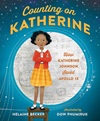
Counting on Katherine: How Katherine Johnson Saved Apollo 13

Last updated Saturday, April 4, 2026
Author: Helaine Becker
Illustrator: Dow Phumiruk
Date of Publication: 2018
ISBN: 1250137527
Grade Level: 1st (GLCs: Click here for grade level guidelines.)
Date(s) Used: Apr. 2026
Synopsis:
You've likely heard of the historic Apollo 13 moon landing. But do you know about the mathematical genius who made sure that Apollo 13 returned safely home?
As a child, Katherine Johnson loved to count. She counted the steps on the road, the number of dishes and spoons she washed in the kitchen sink, everything! Boundless, curious, and excited by calculations, young Katherine longed to know as much as she could about math, about the universe.
From Katherine's early beginnings as a gifted student to her heroic accomplishments as a prominent mathematician at NASA, this is the story of a groundbreaking American woman who not only calculated the course of moon landings but, in turn, saved lives and made enormous contributions to history.
| Discussion topics for before reading: |
| • |
What is a "computer?" Before electronic computers were available, "computers" were very smart humans who could solve difficult math problems!
|
| • |
Is it fair to treat people differently because of their skin color? Or because they are a boy or a girl?
|
| • |
Do you like to count?…do you know any games that make counting fun? (jump-rope, hopscotch, ...)
Vocabulary:
|
| • |
yearned: deeply desired
|
| • |
universe: all existing matter and space considered as a whole; containing all of the solar systems and galaxies.
|
| • |
boundless: without limit
|
| • |
catapult: to jump or "shoot" ahead (medieval catapults hurled stones over castle walls)
|
| • |
segregate: separate into different groups based on race,or age, or gender, or...)
|
| • |
reputation: what people think about you, based on what they have seen you do…good or bad.
|
| • |
orbit: to circle around a planet or star, held in place by gravity
|
| Discussion topics for during/after reading: |
| • |
Why wasn't Katherine allowed to attend the local high school? (Segregation laws…an opportunity to talk about equality of opportunity and the errors of our past).
|
| • |
At first, Katherine had to wait, because jobs for mathematicians were already filled (note: no indication of discrimination in this part of the story). How did Katherine finally succeeded? (Patience and persistence...she did not give up, she kept trying until more jobs became available.)
|
| • |
By using math, Katherine could tell where a ball would land after being thrown. The earth, sun, moon, and spacecraft follow the same rules. Would it be fun to learn math to work space programs like Katherine? Why "yes" or "no"?
|
| • |
Katherine had a reputation as an outstanding "computer"; John Glenn trusted her..and..NASA trusted her to help save Apollo 13. Can you think of people you trust or admire because of their good reputation?
|
| Special activities: |
| • |
Watch a 2 ½ minute NASA video showing the recent Artemis II rocket launch, introducing the astronauts, and
discussing the mission to circle the moon and the future: https://www.youtube.com/watch?v=_eeZQw9PBc0
|
| • |
Watch a 25-second video of the astronauts weightless in space: https://www.youtube.com/shorts/3HCYf71jICo Look for other Youtube videos at the end of the mission.
|
| • |
Make a simple paper airplane or a straw-launched paper rocket and try to "fly" your rocket/plane to land on the
Moon Base (a spot on the carpet or into a trash can). Be careful about eye safety. https://www.youtube.com/shorts/EJR-z5I0hpw
|
*Note: These craft ideas are just suggestions.
You can use them, but you don't have to use them.
You can expand upon them, or add your own twist.
Remember, though, that the focus of your time should
not be on the development and execution of a craft;
the focus should be on the read-aloud and the
enjoyment of the book!
|